By The Squeegee Crew · July 3, 2026 · 7 min read
What soft washing actually is
Soft washing is exterior cleaning that runs at low pressure, about the force of a garden hose, and lets a cleaning solution do the work that raw force can't do safely. Rather than blasting grime off a wall, the solution soaks the surface, kills the algae, mold, and mildew living on it, and a gentle rinse carries the dead growth away.
The clean line between the two methods is this: pressure washing cleans with force, and soft washing cleans with chemistry. A pressure washer for a concrete driveway runs 2,000 to 3,000 PSI. A soft wash runs at 100 PSI or less, close to what comes out of your garden hose. Same water, a fraction of the punch, plus a solution that does the actual cleaning.
That solution is usually a diluted sodium hypochlorite mix with a surfactant that helps it cling to a vertical wall long enough to work. Because it kills the growth at the root instead of knocking the top layer off, a soft-washed surface stays clean far longer than one that's been blasted, often two to three times as long before the film comes back.
Which surfaces need soft washing, and which take a pressure washer
Soft washing is the right method for every delicate surface on your house, and there are more of them than most people expect. Stucco, painted siding, vinyl, wood, fiber-cement board like Hardie, painted trim, and every type of roof, from asphalt shingle to clay tile to metal, all belong on the soft-wash list. These are surfaces that are porous, painted, or fragile enough that force damages them.
Hard mineral surfaces are the opposite. Concrete driveways, patios, walkways, brick, pavers, and natural stone are dense enough to take real pressure, and force is the fastest way to lift the tire marks, foot traffic, and summer dust they collect. Those are pressure-washing jobs, not soft-wash jobs.
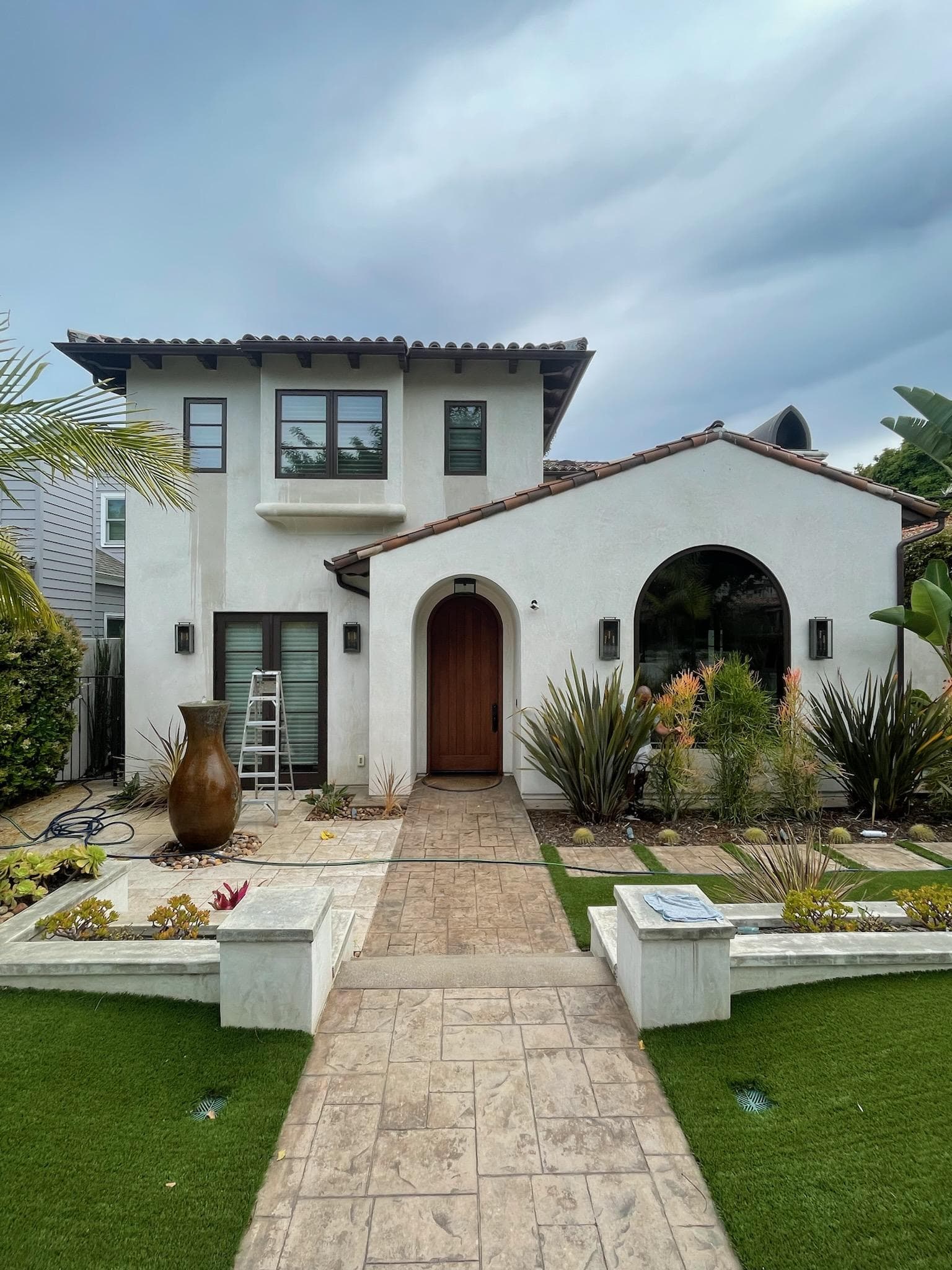
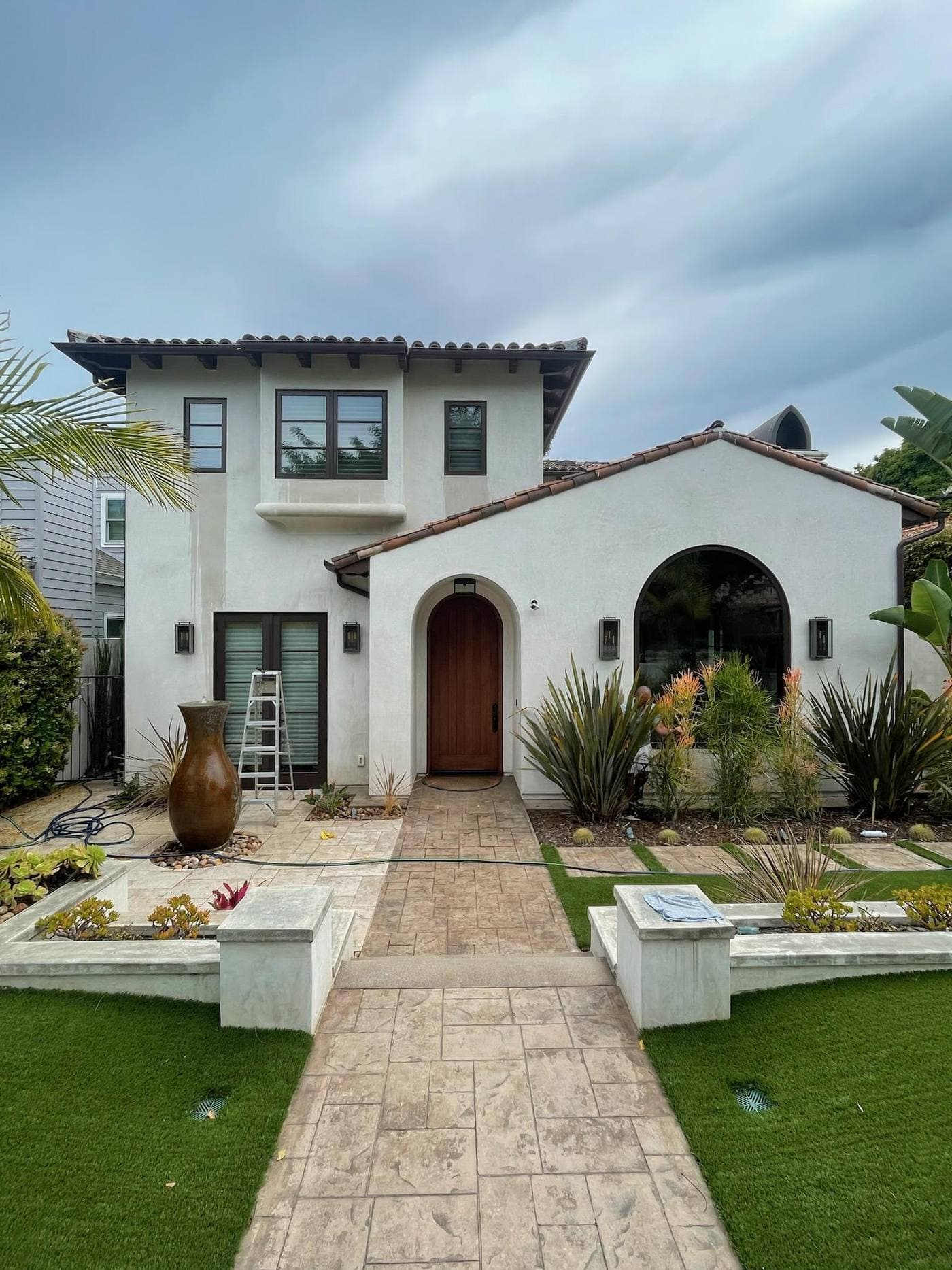
Look at a typical 805 home and you'll see why the split matters. Drive through Ventura, the Santa Barbara Riviera, or the streets below Bishop Peak in San Luis Obispo and the same two materials repeat on every block: Spanish-style stucco walls and red clay tile roofs. Nearly the whole house is soft-wash territory. The driveway and back patio are the pressure-washing part, which is why one visit to a single property usually uses both methods.
Exactly why high pressure wrecks a delicate surface
High pressure damages these surfaces because it goes after the material itself, not just the grime sitting on top. On stucco, a pressure washer cracks and etches the finish coat and drives water in behind the wall, where it has no fast way out. That trapped moisture feeds mold inside the cavity and can rot the framing, and you won't see any of it until the damage is done.
Wood and roofs fail in their own ways. High pressure splinters wood along the grain, tearing out the soft fibers and leaving a furred surface that sheds water worse than it did before the cleaning. On an asphalt-shingle roof, the water strips off the ceramic granules that block UV and give the shingle its lifespan, so you trade a little algae for years off the roof. It can also force water under shingles and tiles and lift or crack clay tile outright.
Siding has the same water-intrusion problem as stucco, with force pushing water up behind the boards or panels. The single most common repair call exterior cleaners get is from a homeowner who rented a pressure washer, aimed it at their own stucco or siding, and turned it up. The machine that makes concrete look new is the wrong tool the moment you point it at the house.
Why coastal 805 walls turn green-black
On the Central Coast, the reason your shaded walls look dingy is biological, not dirt. Salt air off the ocean and the marine layer that rolls in most mornings keep north-facing walls and shaded roofs damp for hours at a stretch, and damp is exactly what algae and mildew need to take hold. The result is a green-black film that spreads across the walls that get the least sun.
North-facing and tree-shaded surfaces are the worst hit because they never fully dry out. Homes near the water, in Pierpont, on the Santa Barbara Mesa, out on the Ventura Keys, take the heaviest salt-and-moisture load. From the curb, that film reads as an old, tired house even when the paint underneath is perfectly sound.
This is also why pressure washing that film is a losing game here. Blasting it knocks the surface growth off but leaves the roots down in the pores of the stucco, so within a season the green-black is back. A soft wash kills it at the root, which is the only reason the wall stays clean through the next foggy stretch instead of graying over again by summer.
The soft washing process, step by step
A proper soft wash runs in four steps: inspect, protect, apply and dwell, then rinse. It starts with a walk around the house to read the surfaces, find cracks or gaps where water shouldn't get in, note which walls carry the heaviest growth, and see where the landscaping sits against the house.
Protecting the plants comes before any solution goes on. The crew pre-wets the soil and foliage around the work area and covers the most sensitive plants, so anything that drifts down lands on already-wet, diluted ground instead of dry leaves. Then the solution goes on at low pressure and is left to dwell, usually five to fifteen minutes, which is the part that actually kills the algae and mildew rather than just wetting it.
Last is a gentle, low-pressure rinse, worked from the top down so the wall sheds cleanly, followed by a second rinse of every plant and every bit of hardscape the solution touched. Skipping the dwell time and trying to force the job with pressure instead is exactly the mistake soft washing exists to avoid.
What soft washing does to your plants and landscaping
Your plants come through a soft wash unharmed when the crew handles three things: pre-wetting, covering, and rinsing. Pre-wetting the soil and foliage means any solution that drifts off the wall lands diluted instead of concentrated. Covering the sensitive plants keeps direct contact off them entirely. And a thorough rinse during and after the job carries any residue down and away before it can sit on a leaf or a root.
The solution itself is heavily diluted before it ever reaches the wall, and plain water is the neutralizer, which is why the rinse matters as much as the wash. A careful crew can clean a stucco wall two feet from a flower bed without harming a thing, and grass and established shrubs shrug off the little that reaches them once it's been watered down. A crew that ignores the landscaping and just starts spraying is showing you how the rest of the job is going to go.
Soft washing versus repainting: the cost math
Soft washing costs a fraction of repainting, and it often buys you years before you need to repaint at all. A full house wash for most 805 homes runs somewhere around $300 to $700 depending on size and access. A full exterior repaint runs $4,000 to $12,000 or more. When the paint underneath is still sound and the problem is just the green-black film on top, washing it is the obvious call.
There's a protection angle too, not only a cosmetic one. The algae and mildew growing on your paint hold moisture against it and break it down over time, so leaving the film up there shortens the life of the paint you already paid for. Clearing it off with a soft wash removes what's degrading the surface, which is part of why a washed house can go years longer between repaints.
Plenty of homes that look like they need painting really just need a wash. It's worth having the walls cleaned first and deciding after, because the difference is often a few hundred dollars against several thousand. A wash can't fix peeling or failed paint, but it can tell you whether the paint was actually the problem in the first place.
Red flags when you hire someone
The clearest red flag is the simplest one: anyone who proposes to pressure-wash your stucco or your roof. Those two surfaces should never see high pressure, and a company that reaches for a pressure washer on them either doesn't know the difference or doesn't care. Either way, keep looking.
A few more tells. If they can't explain what solution they use or why it needs time to dwell, they're blasting, not soft washing. If they have no plan to pre-wet and protect your plants, your landscaping is going to pay for it. And a promise to just blast the whole house clean in one fast pass is a promise to damage the delicate parts of it.
Match the method to the surface and you get a clean house with nothing cracked, splintered, or stripped. The Squeegee Crew soft washes the stucco, siding, wood, and roofs and pressure washes the concrete, across Ventura, Santa Barbara, and San Luis Obispo Counties. We're insured, rated 4.9 stars across more than 190 reviews, and open 24/7. Call (805) 601-7591 and we'll match the right method to every surface on your property.